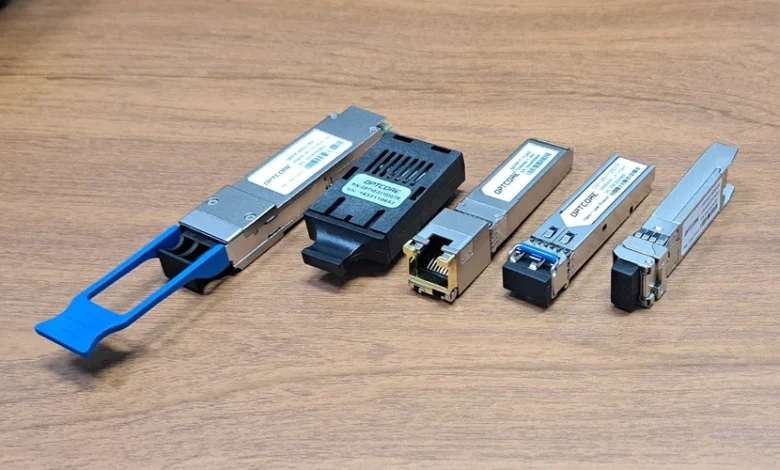
Every video call, cloud upload, streaming binge, online game session, and AI workload relies on something most people never think about. There’s a lot of talk about faster internet, smarter devices, and powerful data centers, but hidden in the networking infrastructure is a small component that does a whole lot of work: the optical transceiver.
It’s not a fancy technology. No influencer is unboxing an optical transceiver and arguing about it over a cup of coffee. But modern digital communication would be impossible without them. They are interested in that quiet way of importance, surprisingly so. Because when you learn what optical transceivers actually do, you begin to think of them as one of the invisible engines driving the connected world.
What does an optical transceiver actually do?
It sounds intimidating, but the basic function is easier to understand than it appears at first. An optical transceiver is a device that transmits and receives data using light signals carried by fiber optic cables. That’s short of it.
Servers, switches, routers, networking gear… all of them are electronic systems. They are powered by electrical signals. Light signals sent through optical fibers are the foundation of fiber optic communication. Somewhere along the line, those electrical signals have to be converted to optical signals, and then the optical signals must be converted back into electrical signals. That conversion work is for the optical transceiver.
It’s like a translator between two languages of communication. Without a translation layer, the networking ecosystem that makes cloud computing, telecommunications, streaming services and enterprise infrastructure possible would look very different.
Optical Transceivers: The Power Is in Your Hands
Digital traffic is expanding relentlessly. Cloud services are still growing. AI workloads are pushing the envelope on infrastructure requirements. Remote work continues to be important in many industries. The amount and quality of streaming content just keeps growing.
All this creates a requirement for faster, more dense and more efficient data transmission. The ability of fibre optics to carry vast amounts of data over long distances at impressive speeds, with relatively little loss of signal, is already vital. Optical transceivers form part of that equation. They help enable data movement within data centers, between network facilities, across telecommunications infrastructure and through enterprise environments.
I came across Roots Analysis, and they say this market is a fast growing one, along with the larger networking and cloud growth trends. Optical transceiver market size is estimated to reach USD 47.64 billion by 2035 from USD 11.54 billion in 2024, growing at a CAGR of 13.753% over the forecast period 2024-2035. That kind of growth is a function of growing demand for bandwidth, the expansion of data centers, 5G deployment and high-performance networking capabilities.
In other words, the digital world continues to ask for more networks, and optical technologies are at the core of meeting those demands.
Optical Transceivers: The Quiet Champions of Data Centers
If there’s one place where optical transceivers really matter, it’s the modern data center Data centers are incredibly hungry ecosystems. Servers are always talking to other servers. There is a lot of traffic flowing between storage systems, compute clusters, networking hardware and external networks.
Latency counts. It is all about efficiency. Reliability is important. Optical transceivers enable high speed interconnectivity in these environments. Transceiver technology evolves to keep pace with the faster standards such as 100G, 400G and increasingly advanced networking architectures that data centres pursue. What is interesting is that these components can be very small physically but very strategic.
The compact optical module inside a switch may be supporting the communication flows that underpin enterprise operations, cloud applications, financial transactions or AI processing workloads. Little Hardware. Big Impacts. Technology works funny like that.
Driving Toward Faster Speeds and Greater Efficiency
Networking is never static. Demand every few years pushes infrastructure to higher bandwidth expectations. The optical transceiver industry is under constant pressure to support higher transmission speeds, and at the same time balance power, thermal, size, and cost issues. The challenge is no trivial one.
The higher the speed, the more engineering challenges come into play in terms of signal integrity, heat dissipation, packaging density and interoperability standards. One practical reality often cited among networking pros is that infrastructure upgrades are seldom as simple as replacing one piece. Compatibility is important.
It needs careful planning about standards, hardware configurations, cable types, deployment strategies and operational requirements for different networking environments. The technology is sophisticated, but the deployment decisions are very practical. Performance is a concern for organizations but so is reliability, manageability and return on investment.
The Challenges of Technology
As with most high-end hardware industries, the optical transceiver industry has its challenges. “There’s the supply chain complexity problem.” The ecosystem is affected by availability of semiconductors, manufacturing precision, sourcing of materials and the global electronics production scenario. Cost pressures are also still important.
High performance networking infrastructure can be expensive, particularly for organizations that manage large scale deployments. Another common worry is about power consumption. In hyperscale data centers, where operational costs can add up fast, the faster the network, the more important it is to find a sweet spot between performance and energy efficiency.
Then there is the relentless pace of technological change in a market driven by increasing standards and rising perfinmance expectations, manufacturers need to innovate continuously to stay competitive. There is not much room for comfortable stagnation in the industry.
Optical Transceivers Beyond Traditional Telecom
Optical networking is often associated with telecommunications providers. It’s understandable that they’d make that connection, but the application landscape is broader than many realize. A key component of cloud computing platforms is optical communication infrastructure.
Financial institutions are in high performance networking environments where the value of speed and reliability is obvious. Advanced optical connectivity solutions can be a huge boon to research computing environments, healthcare systems, enterprise IT ecosystems and AI infrastructure. Adding another layer of relevance is 5G deployment.
As wireless systems evolve, the transport infrastructure behind them is becoming more relevant. Ironically, wireless innovation is highly dependent on wired optical underpinnings. It always strikes me a little funny, the contrast.
Conclusion: Big impact small parts
Optical transceivers don’t make the news headlines very often, but they are the building blocks of today’s networking infrastructure. They connect electrical and optical communications systems, allowing massive amounts of data to travel across the digital landscape As cloud computing, artificial intelligence, telecommunications and data center expansion accelerate, so too will their importance.
Technology combines engineering complexity, market pressures and ongoing innovation challenges. But there is a simple truth lurking beneath all that technical detail. Our connected world runs on invisible systems most users don’t even notice. One piece of that hidden machinery is optical transceivers. Small, specialized and easy to miss, they help carry the endless flow of information that defines modern digital life. And, honestly, there’s something awe-inspiring about technology that can be so physically small, and yet carry something so incredibly consequential.