1. Introduction
Most people think a rat problem starts in the house, but in reality, it often begins far below ground level. You might never see how it started, only the moment it becomes obvious—droppings in a cupboard, scratching in the walls, or strange movement noises at night.
In areas like Chelmsford and across Essex, drainage systems quietly act as hidden routes for rodents. These underground pipes connect homes, streets, and businesses in ways most property owners never think about.
That’s why CCTV Drainage Surveys for Rats have become such an important part of modern Pest control. Instead of reacting to symptoms, they help uncover the actual entry route underground—where the real story begins.
2. Why Rats Prefer Drain Systems More Than Buildings
It may seem strange, but rats often prefer drains over open spaces or even inside buildings. The reason is simple: drains are safe, dark, and connected.
Inside a drainage system, rats can:
- Move without being seen
- Avoid predators completely
- Access food waste easily
- Travel long distances through connected pipes
Even better for them, they rarely need to leave this system unless they find a way into a property.
The problem starts when a small weakness appears—something as small as a cracked pipe or a loose joint. Once that exists, rats don’t need to “break in.” They simply follow the easiest path.
This is exactly the kind of situation where CCTV Drainage Surveys for Rats become useful.
3. Seeing What’s Hidden: How CCTV Drain Inspections Work
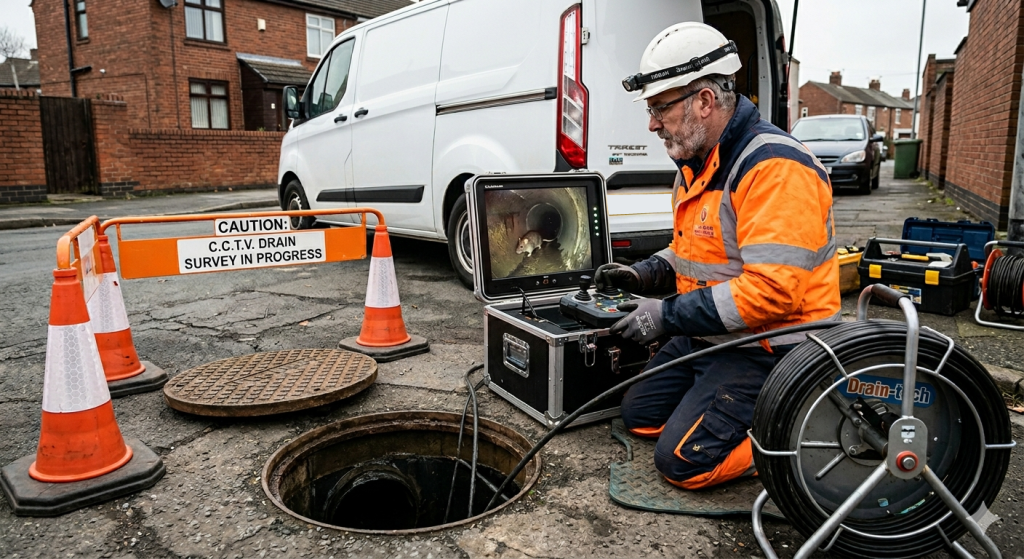
A CCTV drain survey is a straightforward idea in practice. A small waterproof camera is placed into the drainage system and moved through the pipes. As it travels, it sends back live footage of everything happening inside.
This allows technicians to see:
- The condition of underground pipes
- Any visible rodent activity or movement paths
- Cracks, breaks, or damaged sections
- Weak points where rats can enter
The important part is not just spotting rats, but understanding how they are getting into the system in the first place.
In many Pest control cases, this step changes the entire approach. Instead of guessing, there is now clear visual evidence.
4. The Small Defects That Lead to Big Problems
One of the most surprising things about drainage-related rat issues is how small the entry points can be.
During CCTV inspections, common findings include:
- Hairline cracks in old pipework
- Slightly shifted pipe joints
- Unused pipe connections left open
- Poor repairs from past work
- Damaged inspection chambers
None of these seem serious from above ground. But underground, they are open access points for rodents.
Rats are extremely adaptable. If they find even the smallest gap, they will test it, use it, and eventually turn it into a regular route.
That’s why CCTV Drainage Surveys for Rats are so valuable—they reveal problems that are completely invisible otherwise.
5. Why Surface Treatments Don’t Solve the Real Issue
A common reaction to rats is to use traps, poison, or general Pest control treatments. While these methods can reduce the visible population, they often don’t stop the problem from returning.
The reason is simple: the entry point is still there.
If rats are coming through drains, they will keep coming back as long as the route remains open. This is why infestations sometimes feel like they “never fully go away.”
Professionals such as The Exterminator Pest Control often start by checking drainage systems first. Because until the source is found, treatment alone is not enough.
6. What a CCTV Drain Survey Usually Reveals
Every property is different, but drainage inspections often uncover similar patterns.
Some of the most common discoveries are:
- Old pipe systems that have weakened over time
- Construction gaps that were never properly sealed
- Structural movement causing pipe misalignment
- Hidden connections from past renovations
- Sections where water flow has eroded joints
What makes this important is not just the damage itself, but how it connects directly to rodent movement.
Once rats discover a route, they tend to reuse it regularly, creating a stable underground pathway between sewer systems and buildings.
7. The Connection Between Drain Networks and Repeat Infestations
One of the biggest frustrations for property owners is when rats return even after being removed. In many cases, this happens because the drainage system was never checked.
Drain networks are interconnected, meaning:
- One broken section can affect multiple properties
- Rats can move between buildings unnoticed
- Repairs in one area don’t fix the entire route
So even if one infestation is treated, the underlying system may still allow new ones to form.
This is where CCTV inspection becomes a key part of long-term Pest control strategy. It helps map the full underground situation instead of focusing only on visible signs.
8. What Happens After the Survey: Fixing the Root Cause
Once a CCTV drainage survey identifies the problem areas, the next step is usually repair and prevention.
Typical recommendations include:
- Sealing open or unused pipe connections
- Repairing broken or cracked sections
- Re-aligning displaced joints
- Installing rat prevention devices in drains
- Improving maintenance of older pipe systems
The goal is not just to remove rats, but to remove their access route entirely.
Without this step, any pest treatment is only temporary.
9. Why Timing Matters More Than People Realize
Drain-related rat problems tend to grow quietly before they become obvious. By the time signs appear inside the home, the underground issue may already be well established.
Delaying inspection can lead to:
- Larger infestations
- More structural damage
- Higher repair costs
- Greater contamination risks
Early use of CCTV Drainage Surveys for Rats often prevents these situations from escalating. It’s one of those cases where early information leads to much simpler solutions.
10. Conclusion: Understanding the Problem Below Ground
Rat infestations are rarely just surface-level problems. In many cases, they are connected to hidden drainage systems that most people never think about.
By using CCTV Drainage Surveys for Rats, professionals can finally see what’s happening beneath the surface instead of relying on assumptions. It turns a confusing pest problem into something measurable and fixable.
In regions like Chelmsford and surrounding parts of Essex, this method has become an important part of modern Pest control, helping property owners deal with the real source of infestations rather than just the symptoms.