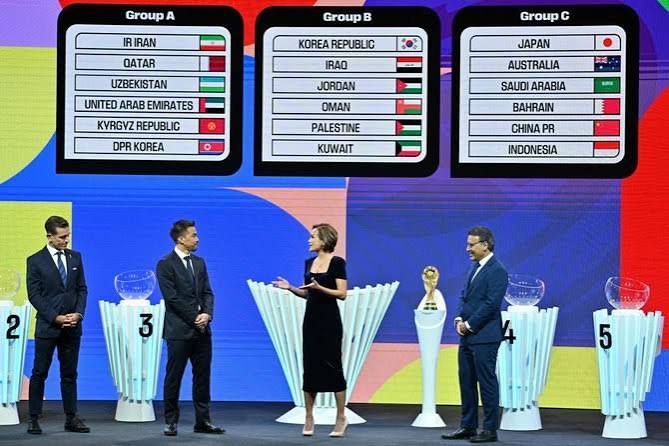
World Cup 2026 is a landmark tournament for Asia, with a record nine AFC nations qualifying and several drawn into groups that will test how far modern Asian football has really come. Watching their full matches with an eye on pressing, structure and chance quality rather than stereotypes lets you see whether this generation can turn “brave performances” into genuine deep runs.
Which Asian nations made it to 2026?
AFC qualifying plus inter‑confederation playoffs have delivered the largest Asian contingent in World Cup history. According to FIFA and tournament previews, nine Asian teams have secured their places in 2026: Australia, Iran, Iraq, Japan, Jordan, Qatar, Saudi Arabia, South Korea and Uzbekistan, with Uzbekistan and Jordan both debuting at a finals reached through qualification rather than hosting.
This expansion reflects both the confederation’s increased slot allocation and real competitive depth. Asian qualifying tables and reports show that Japan were the first to clinch a spot, followed by established powers like South Korea, Iran and Australia, before newer names such as Jordan and Uzbekistan completed the list via later qualifying rounds and playoffs. For viewers, that range of profiles—from tournament regulars to first‑timers—creates very different viewing questions from one Asian side to another.
How the nine Asian teams are distributed across the groups
The draw has scattered Asian teams across almost the entire bracket rather than clustering them together. A summary of group placements shows each Asian side paired with at least one heavyweight and one mid‑tier opponent, creating varied tactical challenges.
| Asian team | Group | Key non‑Asian opponents to note | Immediate viewing implication |
| South Korea | A | Mexico, South Africa, Czechia | Test of build-up vs Mexico’s press and physical duels vs European mid‑tier |
| Qatar | B | Canada, Bosnia & Herzegovina, Switzerland | Examination of mid-block discipline against two strong European structures |
| Australia | D | United States, Paraguay, Türkiye | Intensity battle vs USMNT and transitions vs compact Türkiye |
| Japan | F | Netherlands, Sweden, Tunisia | Positional play and pressing tested by two well-drilled European sides |
| Iran | G | Belgium, Egypt, New Zealand | Low‑block and counter model up against European possession and African athleticism |
| Saudi Arabia | H | Spain, Cape Verde, Uruguay | High defensive concentration vs Spain’s circulation and Uruguay’s aggression |
| Iraq | I | France, Senegal, Norway | Physical and tactical stress test vs world‑class pace and structure |
| Jordan | J | Argentina, Algeria, Austria | Debutants facing elite attacking patterns and varied pressing styles |
| Uzbekistan | K | Portugal, DR Congo, Colombia | First‑time finalists tested by flexible possession teams and powerful dribblers |
Knowing these group contexts in advance helps you read each match’s stakes: some Asian teams are fighting for second or third place; others must treat every point against giants as a bonus that keeps them alive for the expanded Round of 32.
What to look for tactically when you ดูบอลสด these teams
When you ดูบอลสด Asian teams in 2026, the key is to watch beyond effort and atmosphere and into repeatable structural themes. Japan and South Korea typically bring high-intensity pressing and well‑rehearsed rotations in the attacking third, so you should focus on their rest‑defence—how many players stay behind the เว็บดูบอลสดฟรี โกลแดดดี้. when full‑backs push high—and whether they can prevent counters against more clinical European and South American forwards.
Iran, Saudi Arabia and Qatar often lean on compact mid‑ or low‑blocks with sharp counters. For them, key viewing cues include distances between defence and midfield, the timing of line jumps when they decide to press, and how cleanly they can progress from the first pass after a regain. Australia and Iraq sit somewhere between, mixing physical duels with improved ball circulation, while debutants Jordan and Uzbekistan will show whether strong qualifying structures survive the step up in tempo and decision-making required against elite opponents.
Realistic ceilings: who can aim for the knockouts, and who can dream of more?
History and current rankings suggest most Asian sides should treat reaching the Round of 32 or Round of 16 as realistic success, while one or two have an outside shot at going further if the bracket opens up. Recent power rankings and previews typically put Japan and South Korea at the front of the Asian pack, with Australia, Iran and Saudi Arabia forming a competitive second line capable of reaching the last 16 on the right day.
Uzbekistan, Jordan and Iraq arrive as relative unknowns at this level but not as passengers; Uzbekistan in particular are highlighted in FIFA coverage as one of the most tactically organised new qualifiers, while Jordan’s rapid improvement has already produced shock results in regional tournaments. In the expanded format, a disciplined group run and a favourable Round‑of‑32 pairing could push one of these sides into the last 16 for the first time, but anything beyond a quarter-final would require an historic run against multiple higher‑ranked opponents.
How the 48‑team format affects Asian hopes
The new World Cup structure slightly tilts the odds in Asia’s favour without removing the gap in top‑level quality. With 12 groups of four and eight best third‑placed teams also reaching the knockouts, an Asian side can now survive one bad game and still advance by collecting four points or even three with a good goal difference.
This particularly helps teams drawn with one super‑favourite and two more balanced opponents: if they can avoid heavy defeat against the giant and take four points from direct rivals, they can realistically aim for the Round of 32. Conversely, it also means Asian sides must manage risk carefully; an overly open approach against a heavyweight that leads to a heavy loss can wreck goal difference and erase the cushion that the third‑place route should offer.
Where Asian contenders are strongest and weakest in real match situations
Across recent tournaments and qualifiers, Asia’s leading teams have shown clear strengths that you can track live: collective pressing, tactical discipline and improved technical security under pressure. Japan’s calm build‑up against high presses, South Korea’s repeated lung‑busting overlaps and Saudi Arabia’s compact lines against elite sides are all patterns grounded in data from qualifiers and previous finals.
The weaknesses are just as clear: finishing efficiency, depth in central defence and the ability to survive high‑variance matches against physically dominant opponents. In World Cup conditions, Asian teams have occasionally produced high xG but low goals in games they “should” win, while conceding from set‑pieces or single mistakes under aerial pressure. When you watch, note whether an Asian side can turn territorial control and chance creation into actual goals, and whether the second‑choice centre‑backs or full‑backs can maintain concentration late in games after substitutions.
Where the idea of an “Asian breakthrough” can still fail
Talk of an “Asian breakthrough” often spikes before each World Cup, but several structural factors can still derail those hopes. First, despite more slots, AFC teams often draw groups with at least one world‑class opponent, limiting the margin for error; second, travel and time zones in North America impose physical and logistical demands that can test squad depth more severely for teams used to shorter continental tournaments.
Third, the knockout bracket is unforgiving: even if multiple Asian teams reach the Round of 32, they are likely to meet European or South American giants early because of seeding and ranking distributions. For viewers, this means it is useful to celebrate incremental progress—multiple qualifiers, consistent group advancement, more competitive knockout games—without assuming that an Asian semi‑finalist will suddenly become a new norm.
Summary
World Cup 2026 sends a record nine Asian teams into a 48‑nation field, from established powers like Japan, South Korea and Iran to debutants Jordan and Uzbekistan. If you follow their full matches with attention to pressing structures, chance quality and game‑state management, you will see a confederation deep enough to place several sides in the new Round of 32 and a few with a genuine shot at the last 16—while also understanding why turning that wider presence into regular semi‑final runs still demands another leap in finishing, defensive depth and big‑game decision‑making.