
| TL;DRIf you run a creator platform, influencer tool, or marketing SaaS, manual YouTube and Instagram Reels management is eating your team’s time. Phyllo gives you one API that connects to both the YouTube API and the Instagram Reels API. You get normalised creator data, automated metrics, and a white-label connect flow through a single integration. No separate dev teams. No platform-by-platform maintenance. Clean data, delivered fast. |
| Direct Answer: What is the fastest way to automate YouTube and Instagram Reels data management?Use Phyllo. It connects to the YouTube API and Instagram Reels API through a single unified endpoint. You get creator metrics, content performance data, and audience analytics in a consistent data schema — without building or maintaining separate platform integrations. |
The Monday Morning Problem Nobody Talks About
It is 9 AM on a Monday. Your growth team is copying YouTube subscriber counts into a spreadsheet. Someone else pulls Instagram Reels engagement numbers from a separate dashboard. A third person cross-references both to decide which creators to approve for a campaign. By the time all three finish, it is almost noon. And the data is already four hours old.
(ALT Tag: A development team manually pulling YouTube API and Instagram Reels API data into separate spreadsheets across three monitors in a busy tech office)
This happens at creator platforms of every size. And the cost is not just time. Decisions made on stale data produce worse outcomes. Campaigns go to the wrong creators. Monetisation signals get missed. Your product looks slower than it is.
The YouTube API and the Instagram Reels API both exist to solve this. But accessing them directly — managing OAuth tokens, handling rate limits, normalising inconsistent data schemas — creates an entirely different set of problems. Especially at scale.
That is where Phyllo comes in. Phyllo is a creator data infrastructure platform that sits between your product and the social APIs. It absorbs the complexity so your team never sees it.
So here is the real question: at what point does a manual process stop being a workaround and start being the reason your platform is not growing?
Why Manual YouTube and Instagram Management Breaks at Scale
Most teams start manually. You have 50 creators. Someone checks YouTube stats weekly. Another person monitors Reels performance monthly. It holds together. Barely.
Then you hit 500 creators. Then 5,000. The manual process that sort of worked becomes the single biggest bottleneck in your business. And the numbers are not kind.
The Scale Wall
If pulling data for one creator takes 15 minutes across YouTube and Instagram, doing it for 1,000 creators takes 250 hours. Per week. That is not a workflow. That is a full-time team doing a job that should not exist.
The creator economy hit 250 billion USD in 2025 according to Goldman Sachs research. That is the market your platform is competing in. Platforms that cannot move creator data fast enough will not keep up with it.
Every new creator you add makes the manual process worse. Phyllo removes that ceiling by automating the YouTube data layer and the Instagram content retrieval layer simultaneously.
The Multi-Platform Complexity Trap
Building a direct integration with the YouTube Data API takes weeks. Building a separate integration for Meta’s Graph API — which powers Instagram Reels API metrics — takes weeks more. Now you have two codebases to maintain, two rate limit structures to manage, and two versioning cycles to track.
A 2025 survey from Influencer Marketing Hub found that 68% of marketing technology teams cited fragmented creator data as their top operational problem. That is not a niche complaint. That is the majority of teams in this space running into the same wall.
Google updates the YouTube Data API. Meta changes Graph API access tiers. Suddenly your team spends sprint cycles on maintenance instead of features. This is the multi-platform complexity trap. It gets worse over time, not better.
What Actually Breaks When You Scale Manually
- Creator onboarding slows down because each new platform connection needs manual setup
- Analytics dashboards go stale because data does not refresh frequently enough
- Monetisation signals get missed because no one monitors metrics in real time
- Compliance becomes a liability because manual processes cannot enforce data handling rules at volume
- Engineering morale drops because developers maintain integrations instead of building product
All five of these problems share the same root cause: you are managing API complexity manually instead of routing it through infrastructure built for that exact job. That is the gap Phyllo fills.
Meet Phyllo: The Unified API Built for the Creator Economy
Phyllo is not another API wrapper. It is a creator data infrastructure platform. Think of it as the connectivity layer between your product and every major social platform a creator uses.
One integration gives your platform access to creator data from YouTube, Instagram Reels, TikTok, Twitch, Spotify, and over 20 other platforms. You connect once. Phyllo handles everything behind it.
What Phyllo Actually Does
Phyllo handles three things in one package. It manages OAuth authentication for every platform on your behalf. It normalises data from each platform into a consistent schema so you never write custom parsers. And it handles rate limits, token refresh, and API changes without your team noticing any of it.
For platforms in the creator economy space, this is the difference between a two-month integration project and a two-day one.
Who Uses Phyllo
- Creator marketplaces verifying reach before approving campaigns
- Influencer marketing SaaS tools tracking performance across YouTube and Instagram
- Fintech platforms verifying creator income for financial products
- Brand partnership tools benchmarking real-time performance
- Analytics dashboards aggregating multi-platform creator data for brands
Direct Integration vs. Phyllo: Side by Side
| Factor | Direct YouTube API | Direct Instagram Reels API | Phyllo |
| Integration time | 4 to 8 weeks | 4 to 8 weeks | 1 to 2 days |
| Ongoing maintenance | Dedicated engineer | Dedicated engineer | Zero |
| Data normalisation | Manual build required | Manual build required | Automatic |
| Platform coverage | YouTube only | Instagram only | 20+ platforms |
| Rate limit handling | DIY | DIY | Fully managed |
| Compliance support | Build it yourself | Build it yourself | Built in |
| Creator connect UX | Custom build, variable quality | Custom build, variable quality | White-label tested widget |
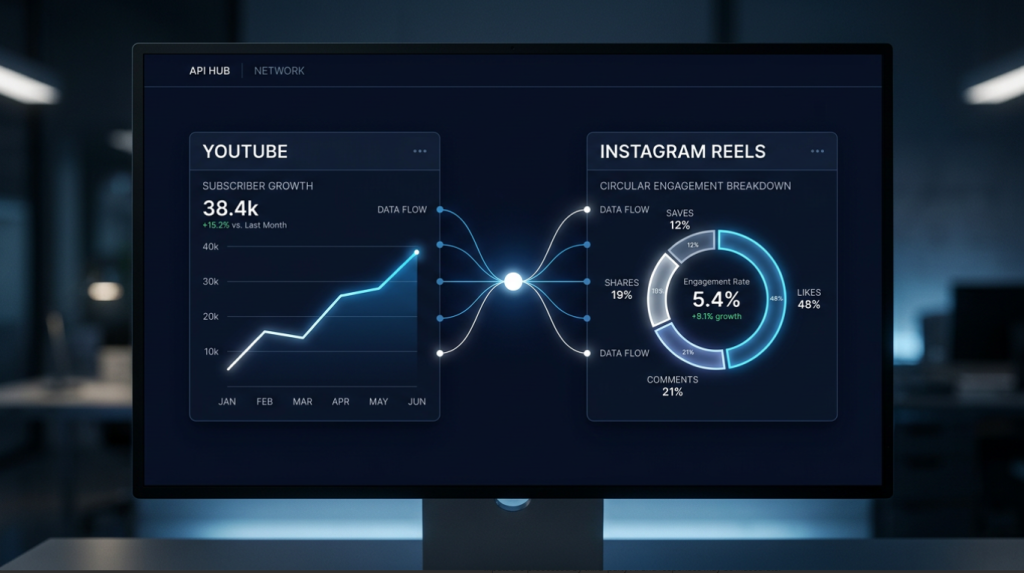
(ALT Tag: A unified creator data API dashboard connecting YouTube API subscriber metrics and Instagram Reels API engagement data through a single integration endpoint)
How Phyllo Handles the YouTube API
The YouTube Data API v3 is powerful and complicated in equal measure. Anyone who has built a direct integration knows the pain of managing OAuth scopes, tracking quota exhaustion, and keeping up with Google’s deprecation notices. Phyllo handles all of that.
What Data Phyllo Retrieves from YouTube
- Channel identity, handle, and verification status
- Subscriber count and growth trends over time
- Video performance: views, watch time, engagement rate, likes, and comments
- Audience demographics: age, gender, and geography
- Revenue and monetisation signals where the creator has granted access
- Content publishing history and upload frequency
Three YouTube API Problems Phyllo Eliminates
OAuth token expiry
The YouTube Data API uses access tokens and refresh tokens. Managing their lifecycle across thousands of creators is a real engineering problem. Phyllo refreshes tokens automatically. Your team never touches it.
Quota exhaustion
The YouTube Data API v3 assigns each project a daily quota. High-volume platforms hit it regularly. Phyllo distributes quota consumption across its infrastructure so your platform never runs dry mid-day.
Schema changes
Google updates its API. Data structures shift without warning. Without Phyllo, your integration breaks and your team scrambles. With Phyllo, the normalised schema your product depends on stays consistent regardless of what happens upstream.
Real Scenario: Creator Verification Before a Brand Deal
An influencer marketing platform needs to verify a creator’s YouTube reach before approving a six-figure campaign. Without Phyllo: a manual pull from YouTube Studio, a screenshot, an email chain. Three days.
With Phyllo: one API call. The creator authenticates through Phyllo’s connect widget. The platform gets live subscriber count, recent video performance, and audience breakdown in seconds. The deal closes faster. The creator gets a better experience. The brand makes a more informed decision.
How Phyllo Handles the Instagram Reels API
The Instagram Reels API is notoriously difficult. Meta’s Graph API has approval requirements, access tiers, and business account restrictions that trip up experienced developers. Reels-specific metrics — plays, shares, saves — sit behind Advanced Access permissions. Getting those requires a formal Meta app review that can take weeks.
And even after you clear the review, data structure differs between creator accounts and business accounts. Phyllo cuts through all of that.
What Phyllo Delivers from Instagram Reels
- Reels play count and total reach
- Engagement rate across likes, comments, shares, and saves
- Follower count and growth trajectory
- Audience demographics: location, age range, and active hours
- Content history and posting cadence
- Creator profile and verification status
How Phyllo Removes Meta’s Complexity
Phyllo has already passed Meta’s app review. Your platform does not need its own Meta developer app to access Instagram creator data. You use Phyllo’s connect flow instead. The creator authenticates directly. Phyllo retrieves the data. Your product receives it in the same normalised format as your YouTube data.
Your engineering team does not need to understand the difference between the Instagram Basic Display API and the Graph API. They call the Phyllo endpoint and get what they need.
Real Scenario: Cross-Platform Campaign Benchmarking
A brand wants to compare a creator’s Instagram Reels performance against their YouTube performance before committing to a campaign. Using separate direct integrations, this means two API consoles, two data pulls, and manual reconciliation in a spreadsheet. Slow and error-prone.
With Phyllo, both datasets arrive through one endpoint in the same schema. The brand’s platform shows YouTube and Reels metrics side by side. The decision takes 10 minutes instead of two days.
Scaling with Phyllo: From 10 Creators to 10,000
(ALT Tag: A creator platform founder confidently reviewing YouTube API and Instagram Reels API performance data on a projected analytics dashboard in a modern office)
The real value of Phyllo shows when your platform grows. Infrastructure that feels optional at 100 creators becomes load-bearing at 10,000.
Infrastructure That Grows With You
Phyllo’s architecture handles high-volume data requests without exposing your platform to per-platform rate limits. It supports both polling and webhooks. You choose scheduled data refreshes or real-time event-driven updates depending on your use case.
When a creator’s subscriber count crosses a defined threshold, Phyllo fires a webhook to your platform automatically. No polling cycle. No wasted API calls. Just the event, when it happens.
Creator Onboarding at Any Volume
Phyllo includes a white-label creator connect widget. You embed it in your onboarding flow. Creators authenticate their YouTube and Instagram accounts through it. Phyllo stores tokens securely. Your platform receives data from that point forward.
A creator can connect YouTube and Instagram in one flow without leaving your product. Less friction in onboarding means fewer creators drop off before completing it.
The Real Cost of Not Using a Unified API
A mid-level backend engineer in the US costs 80,000 to 120,000 USD per year. Maintaining direct integrations with YouTube and Instagram alone requires at least one dedicated engineer. Add TikTok or Twitch and that number grows.
Phyllo costs a fraction of that. It covers more platforms. For most teams, the answer is obvious once you run the numbers.
How to Integrate Phyllo in 4 Steps
Here is what you actually build. These are the real steps, not a vague overview.
Step 1: Create your Phyllo developer account
Sign up at Phyllo’s developer portal. You receive a client ID and client secret. Add them to your backend environment variables. This takes about 10 minutes.
Step 2: Embed the Phyllo connect widget
Phyllo provides an SDK for web and mobile. Configure which platforms to request — in this case, YouTube API and Instagram Reels API. The widget handles OAuth for each. You write zero platform-specific authentication code.
Step 3: Trigger a data retrieval call
Once a creator authenticates, call Phyllo’s unified endpoint with the creator’s Phyllo user ID. You receive YouTube channel data and Instagram Reels metrics in one response. The schema is consistent across both.
Step 4: Plug normalised data into your dashboard
Phyllo returns clean JSON. No transformation needed before display. Pipe it directly into your analytics layer, creator profile page, or campaign approval workflow.
| Pro TipConfigure Phyllo webhooks to fire when a creator’s YouTube subscriber count or Instagram Reels engagement rate crosses a threshold. This removes scheduled polling entirely and keeps your data current without extra API calls. |
Build In-House vs. Use Phyllo: An Honest Look
Building in-house feels like control. In practice, it usually means more maintenance, higher cost, and a slower product roadmap. Here is how the two options compare at a practical level.
| Factor | Build In-House | Use Phyllo |
| Time to first live data | 6 to 12 weeks | 1 to 2 days |
| Ongoing maintenance | Dedicated engineer required | Zero |
| Platform coverage | 2 to 3 APIs maximum | 20+ platforms |
| API change risk | High — breaks on upstream updates | Managed by Phyllo |
| Creator UX quality | Variable — your team builds it | Tested white-label widget |
| Compliance handling | Build it yourself | Built in |
| Time to add a new platform | 4 to 8 weeks per platform | Days |
The only argument for building in-house is deep API-level customisation that Phyllo’s schema cannot support. For 99% of creator platforms, that level of customisation is not needed. Phyllo’s normalised schema handles every use case most teams encounter.
Five Mistakes Teams Make With Creator API Integrations
- Building YouTube and Instagram integrations separately with no unified data model. Two maintenance burdens, two incompatible data formats, zero shared tooling.
- Ignoring rate limits until they cause an outage. The YouTube Data API v3 quota is not generous. Hitting it means no data for the rest of the day.
- Storing OAuth tokens without proper security. Creator access tokens are sensitive. A breach is both a legal problem and a trust problem you cannot undo.
- Not planning for API deprecation. Both Google and Meta have deprecated API versions before. Every direct integration is one deprecation notice away from an unplanned sprint.
- Underestimating onboarding friction. A complicated creator authentication flow drops conversion. The smoother the connect experience, the more creators complete it and stay.
What the Numbers Say About Creator API Adoption in 2025 and 2026
Five Stats That Make the Case
250 billion USD: the size of the creator economy in 2025 according to Goldman Sachs research. It is the market your platform is competing in.
68%: the share of marketing technology teams that named fragmented creator data as their top operational challenge in a 2025 Influencer Marketing Hub survey. This is the majority, not the edge case.
40% faster, 60% less maintenance: what platforms using unified creator data APIs report compared to those running direct integrations. Two numbers that tell the whole story.
22%: the share of total time spent on Instagram that Reels now accounts for, per Meta’s 2025 transparency data. Any platform that cannot access Reels performance data is flying blind on the most-watched format on the platform.
500 hours per minute: the volume of content uploaded to YouTube in 2025. The YouTube API is the only way to make sense of creator data at that scale.
Frequently Asked Questions
Does Phyllo support both YouTube and Instagram Reels in one integration?
Yes. Phyllo connects to both the YouTube API and the Instagram Reels API through a single endpoint. You do not need separate integrations, separate developer accounts, or separate data models. One call returns normalised data from both platforms.
Does my platform need its own Meta developer app to access Instagram Reels data through Phyllo?
No. Phyllo has already completed Meta’s app review. Your platform uses Phyllo’s connect flow instead of maintaining its own Meta app. Creators authenticate through Phyllo and you receive their Reels data on your behalf.
How does Phyllo handle YouTube API rate limits?
Phyllo distributes quota consumption across its infrastructure. Your individual platform does not hit the YouTube Data API v3 daily limit because Phyllo manages requests at scale. You get data without worrying about caps.
Can Phyllo be white-labelled inside my product?
Yes. The Phyllo creator connect widget is white-label by design. You apply your brand styling. Creators see your product throughout the authentication flow, not Phyllo’s.
What happens when YouTube or Instagram updates their API?
Phyllo handles upstream changes. When Google updates the YouTube Data API or Meta revises the Graph API, Phyllo’s team updates the integration. Your data schema stays consistent. Your team responds to none of it.
How long does Phyllo take to integrate into an existing platform?
Most teams go from zero to live data in one to two days. The SDK is straightforward. The creator connect widget drops into existing onboarding flows without a redesign.
Stop Letting Manual Processes Cap Your Growth
Every hour your team spends manually pulling YouTube analytics and Instagram Reels data is an hour away from product work, growth initiatives, and the things that actually move your business.
The YouTube API and Instagram Reels API exist to automate this. But direct access creates its own overhead: OAuth management, rate limits, API versioning, platform-specific data formats. It adds up fast.
Phyllo removes that overhead. One integration. Normalised data from both platforms. A creator connect experience your users trust. Infrastructure that scales with you from 10 creators to 10,000 without adding engineering headcount.
The platforms pulling ahead in the creator economy do not have bigger teams. They have better infrastructure.
| Your first Phyllo integration can go live in two days.Explore Phyllo’s API documentation and see how the YouTube API and Instagram Reels API connect through a single endpoint. Most teams have live creator data flowing before the end of the week. |