Air conditioning problems often begin with subtle warning signs. A room takes longer to cool, airflow feels weaker than usual, or the system starts making a noise that was not there before.
Some issues can be traced to simple causes such as an incorrect thermostat setting or a dirty air filter. Others indicate a mechanical, electrical, refrigerant, or airflow problem that should be evaluated by an HVAC technician.
Knowing the difference can help homeowners avoid unnecessary service calls while also preventing small problems from becoming larger ones.
Start With a Few Basic Checks
Before assuming the air conditioner needs repair, homeowners can perform several simple checks.
First, confirm that the thermostat is set to cooling mode and that the temperature setting is below the current indoor temperature.
Next, check the HVAC filter. A heavily clogged filter can restrict airflow and make a cooling system appear less effective.
Supply and return vents should also be inspected for obstructions. Furniture, curtains, rugs, or other household objects can interfere with airflow.
Finally, check the electrical panel to see whether a breaker associated with the HVAC system has tripped. If a breaker repeatedly trips after being reset, however, that may indicate an electrical issue that requires professional attention.
Warm Air From the Vents
One of the clearest signs of an air-conditioning problem is warm or insufficiently cool air coming from the supply vents.
There are several possible explanations.
A thermostat may be set incorrectly, airflow may be restricted, or the outdoor unit may not be operating properly. Other possibilities include electrical faults, refrigerant-related problems, or failed HVAC components.
If the thermostat and filter appear normal but the system continues blowing warm air, additional diagnosis is usually necessary.
Weak Airflow Throughout the House
An air conditioner may technically be producing cool air while still failing to keep the house comfortable.
Weak airflow can make conditioned air difficult to distribute, especially to bedrooms or rooms located farther from the HVAC equipment.
Possible causes include:
- Dirty air filters
- Blower motor problems
- Damaged or obstructed ductwork
- Restricted return airflow
- Frozen evaporator coils
- Improperly functioning HVAC components
If airflow is weak from only one or two vents, the issue may involve ductwork or air distribution. If it is weak throughout the home, the problem may be closer to the central equipment.
The AC Keeps Starting and Stopping
Air conditioners normally cycle on and off as indoor temperatures change. Problems arise when those cycles become unusually short or frequent.
Short cycling can prevent the system from completing a normal cooling cycle.
Possible causes vary widely and may include thermostat issues, airflow restrictions, electrical problems, frozen coils, or equipment that is not operating correctly.
Because repeated cycling places additional demand on HVAC components, it should not simply be ignored if it continues.
Strange Noises Deserve Attention
HVAC equipment naturally makes some noise when starting, operating, and shutting down. Homeowners generally become familiar with those normal sounds.
A new or unusually loud sound is different.
Rattling may indicate a loose component or debris. Buzzing can be associated with electrical or mechanical problems. Grinding or screeching may point toward moving components that need inspection.
The sound alone is rarely enough to diagnose the exact problem, but it can provide useful information to a technician.
Turning off equipment that is making severe mechanical noises may help prevent further damage until it can be inspected.
Water Around the HVAC System
Air conditioners remove moisture from indoor air as part of the cooling process. That moisture normally drains away through a condensate system.
Water collecting around indoor HVAC equipment can indicate a clogged drain, drainage problem, frozen coil, damaged drain pan, or another issue.
Even a relatively small leak deserves attention because repeated moisture exposure can damage surrounding materials and contribute to indoor moisture problems.
Homeowners should also be cautious about assuming that every HVAC leak is simply condensation.
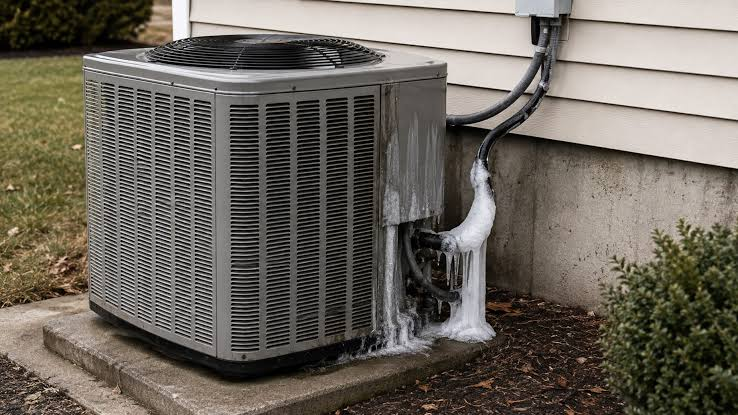
Ice on the Air Conditioner
Ice forming on HVAC equipment might seem surprising during hot weather, but it can occur when operating conditions are not correct.
A frozen evaporator coil may be associated with restricted airflow or other HVAC problems.
If visible ice is present, continuing to run the air conditioner may not solve the underlying issue. The system may need to be shut down and inspected after the ice has melted.
Repeated freezing is especially important to investigate.
The System Runs Constantly
During extremely hot weather, air conditioners may operate for long periods. That does not automatically indicate a malfunction.
However, a system that runs almost continuously while failing to reach the thermostat setting may have a problem.
Restricted airflow, duct leakage, dirty equipment, refrigerant issues, mechanical deterioration, insulation deficiencies, or an improperly sized system are among the possibilities.
The key is to look at both runtime and performance. Long operating periods accompanied by good indoor comfort may be normal during demanding weather. Long runtimes combined with poor cooling deserve closer attention.
Higher Energy Bills Can Be a Clue
Electricity consumption naturally changes with outdoor temperatures and household habits, so one unusually high utility bill does not prove the air conditioner needs repair.
A pattern of increasing energy consumption combined with declining HVAC performance is more significant.
If the system is running longer to provide the same amount of cooling, homeowners may notice both higher utility usage and reduced comfort.
Comparing current performance with previous seasons can help identify changes that are worth investigating.
When to Call an HVAC Professional
Professional service becomes appropriate when basic troubleshooting does not correct the problem, particularly when the system is producing warm air, repeatedly shutting down, leaking water, freezing, making significant noises, or failing to cool the home.
Homeowners looking forAC repair in San Antonio can consult Cowboys Air Conditioning & Heating, a local HVAC company serving the San Antonio area with cooling, heating, ductwork, maintenance, and related residential HVAC services.
Professional diagnosis is especially important when a problem involves electrical components, refrigerant, internal mechanical parts, or equipment that must be disassembled.
Attempting complex HVAC repairs without the appropriate training can create additional equipment damage and introduce safety risks.
Repair or Replace?
Not every malfunction means the entire air-conditioning system needs replacement.
Many problems can be repaired, particularly when equipment is otherwise operating reliably.
Replacement becomes a broader consideration when an aging system requires frequent repairs, struggles consistently to maintain comfort, or develops a major component failure.
Homeowners should consider the equipment’s age, overall condition, repair history, efficiency, and expected repair costs before making a decision.
A technician can explain the immediate fault and provide information that helps the homeowner compare available options.
Early Warning Signs Matter
Air conditioners rarely become more reliable when developing problems are ignored.
Changes in airflow, temperature, noise, cycling behavior, moisture, or energy consumption can all provide early indications that something is wrong.
Basic homeowner checks can resolve some simple issues, but persistent symptoms deserve professional diagnosis.
Paying attention to those warning signs can make it easier to address an HVAC problem before the system stops cooling altogether, particularly during periods when reliable air conditioning matters most.