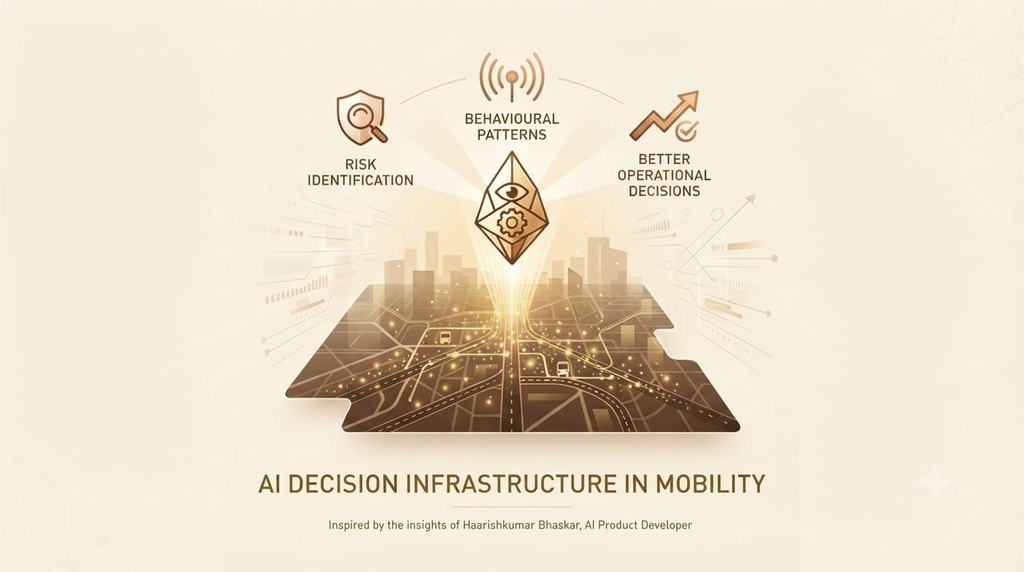
Artificial intelligence in mobility is moving beyond customer-facing chatbots and recommendation systems. As mobility platforms handle growing volumes of rides, transactions, driver activity and operational data, AI is increasingly being applied to a less visible but increasingly important area: helping platforms identify risks, understand behavioural patterns and make better operational decisions.
According to Haarishkumar Bhaskar, AI Product Developer, the value of AI in mobility is not limited to adding an AI feature to an existing application. The larger opportunity lies in using data generated across the platform to build intelligence into operational and product decisions.
“The most meaningful AI applications in mobility are often the ones users never directly see. When a platform can identify unusual behavioural patterns, recognise potential risks and provide actionable intelligence to its operations teams, AI becomes part of the product infrastructure rather than simply another interface,” Haarishkumar explains.
From Data Collection to Behavioural Intelligence
Mobility platforms generate multiple categories of information during everyday operations. Ride requests, cancellations, trip completion, driver activity, payment events, location patterns and user interactions can collectively provide signals about how a platform is functioning.
However, collecting this information is only the first step.
The challenge is converting these signals into useful intelligence.
Haarishkumar believes AI systems should be designed around specific product and operational problems rather than introduced simply because the technology is available.
“The first question should not be ‘Where can we add AI?’ It should be ‘Which decision are we trying to improve?’ Once that is clear, the data, model and product workflow can be designed around that decision,” he says.
This approach can be particularly relevant to fraud detection and behavioural risk management, where individual events may appear normal but combinations of events can reveal unusual activity.
Why Behavioural Signals Matter
Traditional rule-based systems can identify predefined conditions, such as repeated failed transactions or unusual account activity. AI-based approaches can complement these systems by identifying relationships and patterns across multiple variables.
For mobility platforms, this could involve analysing combinations of user, driver and transaction behaviour to identify activity requiring further investigation.
Haarishkumar describes this as a shift from simply detecting individual events to understanding behavioural context.
“A single event rarely tells the complete story. The useful signal can emerge from the relationship between multiple events over time. AI can help surface those patterns so that operational teams can investigate them more efficiently.”
Such systems do not necessarily need to make an automatic final decision. In many product environments, AI can instead act as an intelligence layer that assigns risk signals or prioritises cases for human review.
AI Should Support Product Decisions
Another emerging application is operational intelligence.
Mobility companies must continuously make decisions involving fleet utilisation, driver activity, trip completion, demand patterns and service reliability. AI can assist by identifying trends that would otherwise require extensive manual analysis.
For Haarishkumar, this represents an important distinction between an AI-powered product and a product that merely contains an AI feature.
“An AI product should change how decisions are made. If the model produces a prediction but nobody knows what action to take from that prediction, the technology has not created enough product value.”
This product-oriented approach places equal importance on the workflow surrounding an AI model.
The model needs appropriate data, but the resulting insight must also reach the person or system responsible for taking action.
Building AI Around Real-World Constraints
Developing AI systems for mobility also introduces practical challenges. Data quality can vary, user behaviour can change and operational environments are rarely static.
A model that performs effectively under one set of conditions may require continuous monitoring and refinement as the platform evolves.
Haarishkumar argues that AI product development therefore requires an understanding of both technology and user behaviour.
“AI systems operate inside products, and products operate inside real-world environments. You have to understand the users, the operational workflow and the business problem alongside the technical implementation.”
This perspective is particularly relevant as companies increasingly move from experimentation with generative AI toward more specialised AI systems designed for measurable operational outcomes.
The Next Stage of AI in Mobility
The next phase of AI adoption in mobility may therefore be less about visible AI interfaces and more about intelligence embedded within the platform itself.
Fraud and behavioural risk detection, predictive safety, fleet intelligence, demand forecasting and operational decision support are examples of areas where AI can operate largely in the background while influencing the performance of the overall product.
For Haarishkumar, the objective is ultimately to make technology useful rather than simply sophisticated.
“The strongest AI products will not necessarily be the ones with the most visible AI. They will be the ones where intelligence is connected to a real problem, integrated into the product workflow and capable of improving the decisions that matter.”
As mobility platforms become increasingly data-driven, this shift from AI as a feature to AI as decision infrastructure could become an important part of how the next generation of mobility products is designed.