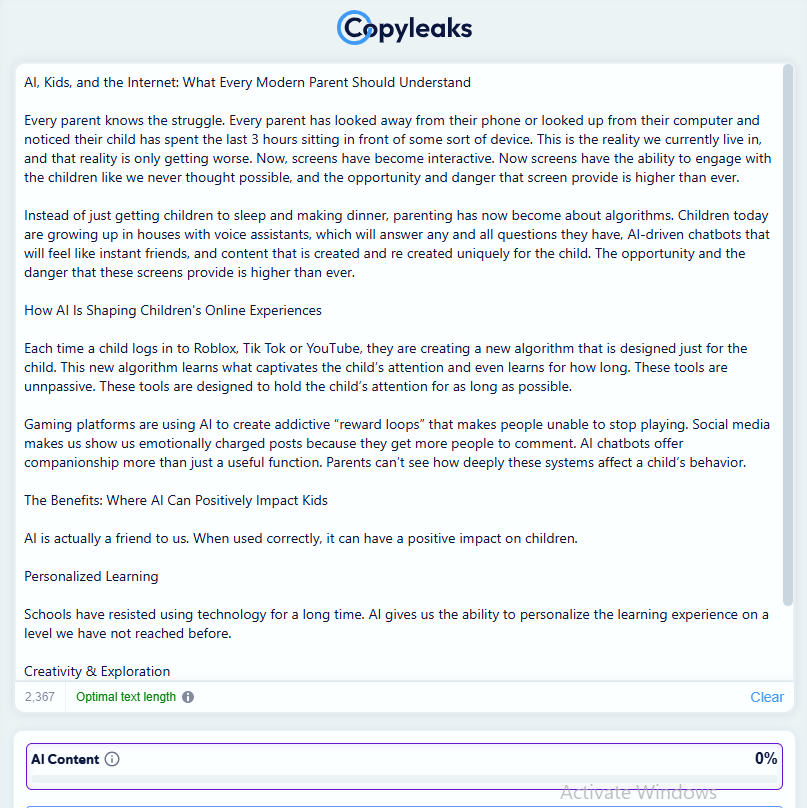
There is something that every parent can relate to. You look up from your phone and look around the room and realize that your child has been on the screen for 3 hours and neither of you noticed how it happened. I’ve been there. Most of us have. But here’s what’s different now: the screen stares back. Welcome to the age of AI-powered digital experiences, where algorithms are designed to know your child better than you do.
Parenting has evolved from just setting bedtimes and planning meals. It’s algorithmic now. Today’s kids are born into a world where voice assistants of the household answer any queries they may have, AI-powered chatbots feel like friends, and content is curated just for them. The opportunity and the dangers are at their peak.
How AI Is Shaping Children’s Online Experiences
Each time a child logs into YouTube, TikTok, or even the gaming platform Roblox, a new algorithm has been built to understand each child. They learn what captivates the kids attention and for how long. These aren’t passive tools; they are sophisticated engagement engines tuned to maximize time on screen.
Gaming platforms use AI to create “reward loops” which are small dopamine hits that make it hard to stop. Social media feeds surface emotionally charged content because it drives more interaction. AI-powered chatbots are increasingly positioned as companions, not just tools. The influence of these systems on a child’s attention and behavior is profound and largely invisible to parents.
The Benefits: Where AI Can Positively Impact Kids
AI isn’t the villain here. In fact, it can be genuinely transformative for kids when thoughtfully designed.
Personalized Learning
Adaptive education platforms like Khan Academy use AI to identify where a child struggles and adjust accordingly. Instead of a one-size-fits-all curriculum, kids learn at their own pace. Resistance to new educational technology is nothing new, but AI’s ability to personalize learning is a genuine step forward.
Creativity & Exploration
AI tools are helping kids write stories, compose music, and build apps, all skills that previously required years of formal training. For children with disabilities, AI-powered text-to-speech, real-time captioning and adaptive interfaces are opening doors that were once firmly closed.
The Risks Parents Can’t Ignore
The benefits come with serious trade-offs, and awareness is the first line of defense.
- Inappropriate content: Algorithm-driven feeds can bypass filters, surfacing disturbing or age-inappropriate material faster than any parent can react.
- Online predators: AI moderation is imperfect. Predatory behavior online remains a documented threat, as platforms struggle to fully contain anonymous abuse despite technological efforts.
- Addictive design: Engagement algorithms are purpose-built to keep kids hooked. Prolonged exposure to short-form video content is linked to reduced attention spans and a preference for instant gratification over deeper focus.
- Data privacy: Children’s behavioral data (what they watch, how they play, what they search) is collected at scale. Laws like COPPA offer some protection, but enforcement gaps remain wide.
When Technology Fails: The Rise of Legal Challenges
The cracks in the system are showing up in courtrooms. In March 2026, juries in Los Angeles and New Mexico found Meta and YouTube liable for designing platforms with addictive features that harmed young users. Thousands of similar cases are making their way through the legal system.
Gaming platforms are facing parallel scrutiny. If you want to understand the growing legal exposure around platforms marketing to children, the breakdown of the Roblox lawsuits and what they mean for parents is a sobering read. These cases reveal systemic design choices that prioritized engagement over child safety.
Why AI Moderation Alone Isn’t Enough
Automated moderation can catch millions of harmful interactions a day. What it cannot do is understand context, detect nuanced grooming behavior or keep pace with bad actors. There will always be a gap between platform policy and real-world enforcement. Human oversight, ethical design and genuine accountability are the missing pieces.
What Parents Should Do: Practical Steps
- Know the platforms: Download the apps your kids use. Spend 20 minutes inside them. What you find will surprise you.
- Set digital boundaries: Research confirms that intentional screen-time limits make a measurable difference for children’s mental health.
- Use parental controls as a starting point: Tools like Google Family Link and Apple Screen Time are helpful, but they work best when paired with active parental involvement, not as a substitute for it.
- Teach critical thinking: Talk to your kids about how algorithms work. Explain that what appears in their feed is not random; it’s engineered. That single conversation can change how they engage with every platform they ever use.
The role of businesses and platforms
Tech companies are not neutral parties. The World Economic Forum warns that AI companions introduced to young children without guardrails risk distorting the fundamental process of human development. Ethical AI isn’t just good PR; it’s becoming a competitive advantage. Trust, once broken, is hard to rebuild, and companies that lead with safety will earn long-term loyalty.
The Future: Safer AI or Bigger Risks?
Regulation is coming. The EU AI Act, proposed U.S. legislation, and bipartisan support for children’s digital protections signal the era of self-regulation is ending. Smarter safety tools are also emerging, but so are smarter threats. The arms race between harm and protection isn’t over; it’s accelerating. Parental awareness, meanwhile, is rising, and that may be the most important variable of all.
Conclusion: Parenting in the Age of Algorithms
AI is not a problem solved by keeping children offline. The challenge (and the opportunity) is raising kids who can navigate AI-driven environments with confidence and healthy skepticism. Entrepreneurs and technologists are wrestling with these same questions, and there are no perfect answers. But parents who stay curious and engaged are the ones who will raise children who thrive, not despite the algorithm, but because they understand it.
Awareness plus action equals safer digital experiences. That equation is still very much in your hands.