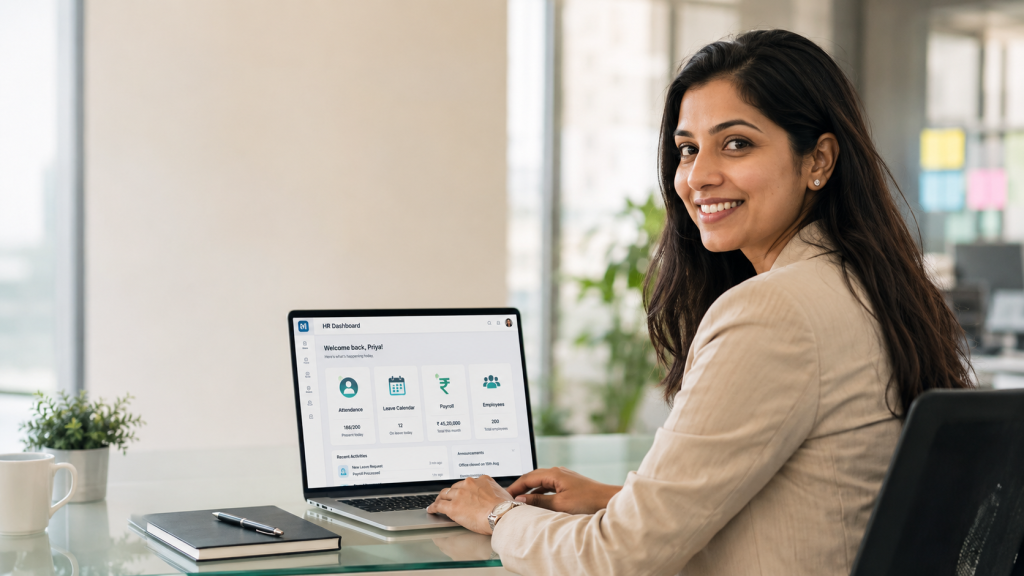
Every HR professional in India knows the feeling: a Monday morning that starts with three leave approval requests, a payroll query from someone whose PF deduction looks off, and a new hire whose documents still haven’t been verified.
This is exactly the issue HRMS software is built to solve, as the real value is how much of the daily grind gets automated so people can focus on work that actually needs a human.
What does ‘Simplifying HR Operations’ actually mean?
In practice, ‘Simplifying HR Operations’ means replacing manual, repetitive processes with automated workflows that require minimal HR intervention.
Spreadsheets, email chains, and physical files are still common in many Indian organisations, and each one comes with a hidden cost: time lost to re-entry, errors that surface only during audits, and employees frustrated by slow turnaround on simple requests.
An HRMS not only digitises these processes but also removes the manual steps altogether wherever possible. So, if you are evaluating the best HRMS software in India, you should ensure that they provide practical solutions to your exact challenges.
Simplifying Daily HR Work with HRMS Software
Let us understand how HRMS software simplifies the daily work of HR teams by going through each module separately:
Attendance and Time-tracking
HRMS platforms automate clock-ins through biometric, geo-tagged, or app-based check-ins, giving HR real-time visibility into attendance without manual registers or follow-ups. Shift schedules, late marks, and overtime calculations update automatically, removing the month-end scramble to match attendance data before payroll runs.
Leave Management
Employees apply for leave through a self-service portal, see their balance instantly, and get routed to the right approver automatically. HR no longer needs to track leave balances manually or answer employee queries, as the system answers them instantly, and approval workflows move without HR chasing signatures.
Payroll Processing
Payroll is where manual errors are costliest. HRMS software auto-calculates salaries, statutory deductions, and reimbursements based on attendance, leave, and tax inputs, then generates payslips without manual computation. Platforms with AI-powered payroll systems go further, flagging anomalies before disbursal itself.
Employee Self-Service (ESS)
An Employee Self-Service portal lets employees update personal details, download payslips, raise queries, and track request status without emailing HR. Such automation eliminates a large share of the routine tickets that consume an HR generalist’s day. Some platforms now layer conversational tools, like a chatbot, on top of ESS, so employees get instant answers to policy questions instead of waiting on a response.
Onboarding
Digital offer letters, e-signatures, and automated document collection replace the paper trail that traditionally drags new-hire onboarding out over days. Automated welcome workflows, including system access, policy acknowledgment, induction scheduling, etc., run in the background instead of depending on a checklist someone has to remember to complete.
Statutory Compliance
Statutory compliance like PF, ESI, TDS, and Professional Tax calculations vary by state and update with regulatory changes, and manual tracking carries hefty penalty risks. HRMS platforms built for the Indian market automate these calculations, generate compliance reports, and send deadline reminders, reducing the chance of a missed filing or a miscalculated deduction.
Beyond Time Savings
The immediate benefit of HRMS adoption is saved time and increased efficiency. However, the second-order effects matter more over the long run:
- Fewer errors in payroll and compliance reduce audit risk and rework.
- Faster turnaround on employee requests improves trust in HR as a function.
- Better data accuracy feeds more reliable workforce reporting for leadership.
- Freed-up HR bandwidth shifts focus on engagement, retention, and culture-building.
Choosing the Right HRMS
Not every platform delivers the same level of simplification. When evaluating options, HR leaders should look for:
- Ease of use, for both HR admins and employees, as a powerful system nobody wants to open defeats its purpose.
- Mobile access, since a large share of routine HR interactions now happen remotely and are not bound by office timings.
- Integration capabilities with existing finance, attendance hardware, or communication tools, as HR is an integrated department.
- India-specific compliance depth, which is able to stay up to date with the ever-changing Indian labour laws and tax slabs.
- Flexibility and scalability, so the system holds up as headcount grows, while catering to custom requirements of the organization.
Conclusion
For organisations evaluating the best HRMS software in India, the deciding factor should be how many daily challenges the platform resolves, instead of focusing on how many features are listed on the pricing page.
FAQs
What is HRMS software used for?
HRMS software automates core HR functions like attendance, leave, payroll, onboarding, and compliance, reducing manual work and centralising employee data in one platform. These systems are capable of enhanced automation, providing HR teams with more time for strategic HR tasks.
How does HRMS help with payroll compliance in India?
HRMS automates PF, ESI, TDS, and Professional Tax calculations based on current statutory rules, reducing manual errors and missed filing deadlines. It also remains up to date with the latest changes, helping HR teams stay abreast of compliance in India.
Is HRMS software only for large companies?
No, cloud-based HRMS platforms are now scaled for SMEs too, offering the same automation benefits without the infrastructure cost of legacy systems. Hence, it can be used by all kinds of businesses, ranging from startups to enterprises.
How does employee self-service reduce HR’s workload?
ESS portals let employees handle routine tasks, such as leave requests, payslip downloads, detail updates, etc., cutting the volume of queries HR fields daily. It helps HR teams reallocate their working hours into strategic tasks instead of simply answering employee queries.