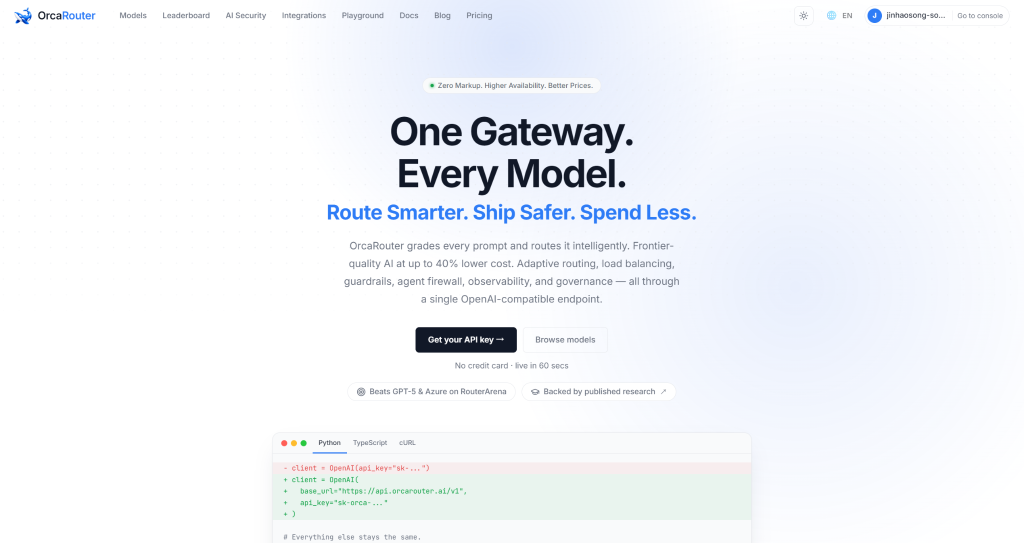
Over the past few years, one API shape quietly became the industry’s default: the OpenAI API format. So many tools, SDKs, and providers now speak it that “OpenAI-compatible” has turned into a feature you look for when choosing infrastructure. But what does it actually mean for an API to be OpenAI-compatible, and why should it influence your architecture? The short version: it is the closest thing the LLM world has to a universal plug, and it is your best defense against lock-in.
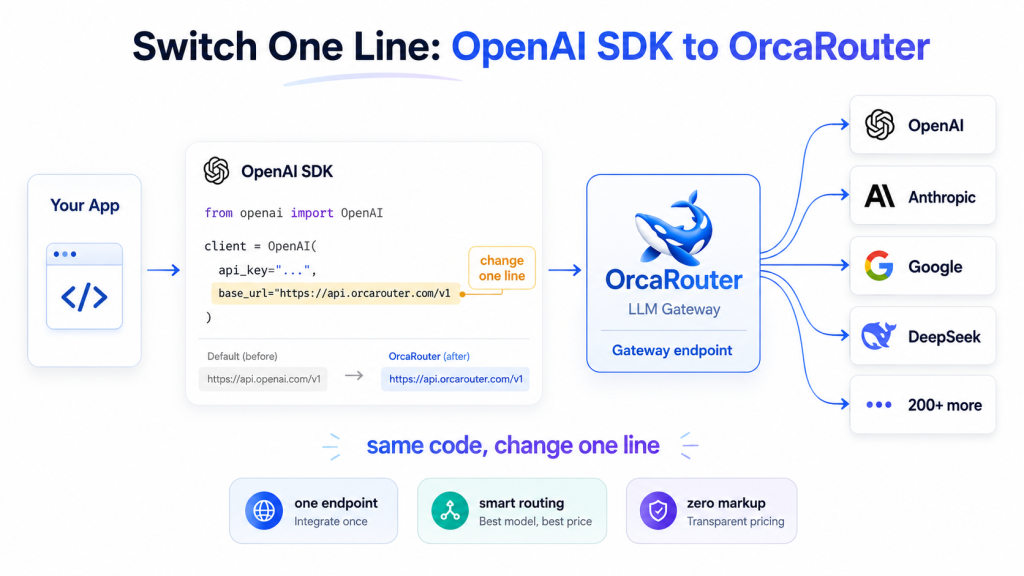
It is also what makes a tool like OrcaRouter drop-in. Because it is an OpenAI-compatible LLM gateway, you point your existing OpenAI SDK at a new base URL and instantly reach 200+ models — no new library, no rewrite. Let’s unpack what compatibility means, why it matters, and how to use it to keep your options open.
What “OpenAI-compatible” means
An OpenAI-compatible API accepts the same request and response format as OpenAI’s own API — the same endpoints, the same JSON shape for messages, models, and settings, and the same streaming behavior. In practice that means any client library written for OpenAI will work against the compatible service with no code changes beyond the base URL and API key. The provider on the other end might be a different company or a gateway fronting many models; your code neither knows nor cares.
Why it matters
OpenAI compatibility is not a nice-to-have; it is leverage. Three reasons it matters:
- No rewrite — keep the SDK and code you already have; switching services is a config change, not a project
- No lock-in — because the format is portable, you can move between providers or gateways without re-engineering
- A bigger ecosystem — tools, frameworks, and agents built for OpenAI (Cursor, LangChain, the Vercel AI SDK, and more) work out of the box
Put together, compatibility turns your model choice from a permanent commitment into a reversible decision — which is exactly what you want in a fast-moving field.
How it works in practice
Using an OpenAI-compatible service is almost anticlimactic. You take the same client you already use, set two values — the base URL of the compatible service and your API key for it — and set the model string to whatever the service supports. Every call you already wrote keeps working. If the service is a gateway, that one change is the moment your app goes from single-model to many-model.
Using compatibility to reach every model
The most valuable use of an OpenAI-compatible API is as the front door to a gateway. Instead of a compatible endpoint that reaches one model, a gateway’s compatible endpoint reaches hundreds — so a single base-URL change gives your OpenAI code access to models from many providers, with routing, failover, and one bill. OrcaRouter works this way: one OpenAI-compatible endpoint, 200+ models, automatic failover, and zero markup on tokens.
What to check
Not all “compatible” services are equally complete. Before you rely on one, confirm it supports the features you use — streaming, tool calls, and structured output — and that it fronts enough models to be worth adopting. A gateway that is fully compatible and broad in model coverage gives you the most freedom for the least effort. It is also worth a five-minute smoke test: run one real request through the compatible endpoint with your existing client before you migrate anything, so you can confirm the drop-in claim holds for your exact stack rather than taking it on faith.
How to get started
- Create a free account and generate an API key
- Set your OpenAI SDK’s base URL to the compatible endpoint and use your new key
- Set the model string to any model the service supports
- Ship — and switch models later by changing one string
OpenAI-compatible vs a proprietary API
A proprietary API has its own unique request format that no other client speaks. It can be perfectly good on its own, but it isolates you: every integration, tool, and teammate has to learn that specific format, and moving away from it means rewriting. An OpenAI-compatible API is the opposite — it deliberately adopts a shared format so your code is portable across services. In a field where the best model changes every few months, portability is worth more than any single provider’s bells and whistles. The practical rule of thumb: prefer compatible endpoints for anything you expect to maintain for more than a quarter, and treat a proprietary-only format as a cost you will eventually pay to undo.
The ecosystem advantage
Compatibility also plugs you into a large, ready-made ecosystem. Popular developer tools — code editors like Cursor, agent frameworks like LangChain and LlamaIndex, and the Vercel AI SDK — are built to talk to the OpenAI format. Point them at an OpenAI-compatible gateway and they instantly gain access to every model behind it, with no custom adapters to write or maintain. That means your choice of gateway does not just serve your own code; it upgrades every tool in your stack at once.
This is the quiet reason OpenAI compatibility has become a default expectation rather than a differentiator: it is the interface that lets the whole ecosystem interoperate. Choosing a compatible gateway is how you stay inside that ecosystem while keeping every model on the table — you get the tools, the portability, and the model breadth in a single decision.
The bottom line
OpenAI compatibility is the closest thing this industry has to a universal plug, and the smart move is to treat it as non-negotiable: build against the standard, point it at a gateway, and every model on the market becomes a config value instead of a migration. Portability is the one feature that keeps paying off no matter which model wins next quarter.
Want to reach every model without a rewrite? Point your OpenAI SDK at OrcaRouter — an OpenAI-compatible endpoint to 200+ models, with automatic failover and zero markup.
FAQ
Do model-specific parameters break OpenAI compatibility?
Occasionally — models differ in which optional parameters they honor (some ignore certain sampling settings, others reject them). Compatible services normalize most of this, but when switching models, re-test any call that leans on less-common parameters.
Are function calls and JSON mode identical across compatible providers?
The request shape is the same, but behavior quality varies: some models follow tool schemas more reliably than others. Compatibility guarantees your code runs; it doesn’t guarantee every model performs equally on structured tasks, so validate outputs when you swap.
Does OpenAI compatibility cover embeddings and audio too?
Mostly chat completions; embeddings endpoints are commonly mirrored as well, while audio and image endpoints are less consistently supported. If your product uses those, confirm the specific endpoints before committing to a compatible service.